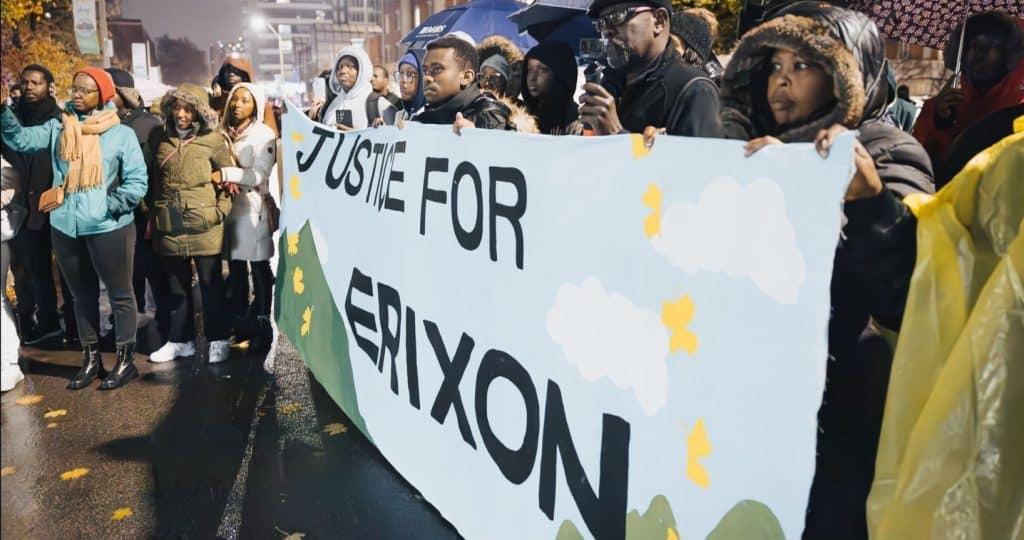
Outside Hamilton City Hall after sunset, hundreds huddle in a covered space under the council chambers. On this rainy mid-November day, it has been five days since Erixon Kabera, a well-known and beloved member of the local Rwandan community, was shot and killed by local police. There are greetings and some smiles, but also tears and anxious eyes; most people in the crowd are Black. Several have brought handmade signs demanding justice and answers. One such sign reads, “Who do you call when the murderer is a cop?”
Erixon’s close friend Andy Ganza is acting as emcee for this vigil, and soon introduces three boys on the makeshift stage area as Kabera’s sons: Garry Sean, Terry, and Zack. Standing with them is Kabera’s wife, Lydia, holding a fluorescent green sign that simply reads, “We need answers.” Throughout the evening Ganza welcomes speakers from community and faith groups, Rwandans and Kenyans, Trinis and Nigerians, and a historian from Stewart Memorial Church, a space established nearly 200 years ago by Black people who escaped enslavement in the United States via the Underground Railroad.
Kabera’s death is “another senseless killing by those we are told are there to protect us,” says Ruth Rodney of the Afro Canadian Caribbean Association of Hamilton, her voice rattling with emotion, “What can we honestly say that has not already been said time and time and time again? It’s all been said before, but the country is still not listening.”
Those gathered speak at length of Kabera’s life of community service and care, of his work on numerous organizations, of his love for his family. But in relation to his death, most do not elaborate, in part because this is a vigil of remembrance, but also in part because the community and public have received so little information about exactly how and why Hamilton police killed Kabera. Others seem to choose their words carefully to manage a palpable collective rage that, like the evening’s rain, is always present but never builds into a storm.
Telling our own stories.
Creating community-powered journalism that centres and celebrates Black, Indigenous and communities of colour in Canada.
Police in Canada are increasingly killing civilians, especially Black and Indigenous ones. This country congratulates itself for welcoming once-enslaved Black refugees and asylum seekers from the United States. But today, local and regional police forces are increasingly killing Black immigrants, particularly men from African countries, wherever they seem to settle in Canada.
Calgary police killed Latjor Tuel, a South Sudanese immigrant, at a bus stop in February of 2022. Omar Mohammed was shot and killed inside an employment office by a Royal Newfoundland Constabulary officer in June of 2023. On the final day of 2023, Winnipeg police killed Afolabi Stephen Opaso, a teenage international student from Nigeria. Each of the men was reportedly experiencing a mental health crisis when police responded with lethal force.
Nationally, nine Indigenous people died at the hands of police in a two-month period over the summer. Family members and the Assembly of First Nations have demanded a federal inquiry into the killings; the government has not agreed to one. Yet no inquiry is needed to contextualize the disproportionate police killings of Indigenous people. Police act now as they have done since the 1880s, when the North-West Mounted Police — now the Royal Canadian Mounted Police — restricted the movement of Indigenous peoples on behalf of white colonizers and settlers.
The agencies that oversee local police almost always justify their killings. More commonly, police harm someone but don’t kill them, yet even in those cases, investigative bodies give cops a pass. In Kabera’s case, the Special Investigations Unit (SIU) initially claimed there was “an exchange of gunfire” between Kabera and Hamilton police officers at his apartment in the late afternoon of Nov. 9. The following day, the SIU issued a correction that “based on information that has come to light in the course of the investigation, it does not appear that the man discharged a firearm.”
About 90 minutes after its officers had shot Kabera, Hamilton Police Service posted to X (formerly Twitter) that an officer had been injured and taken to hospital after being “confronted by a male with a firearm.” A reasonable reader might easily assume that Kabera had shot and wounded an officer before being killed.
However, the SIU says it found a replica firearm at the scene. Replicas are, by definition, not firearms and can’t discharge harmful projectiles. While the SIU now says Kabera never shot at police, after claiming he did, it has not clarified whether it believes Kabera ever touched or even possessed the replica gun. As of the publication of this piece, more than six months later the police’s misleading tweet is still posted.
Year after year, Hamilton police data reveals disproportionate uses of force against Black residents. Police reply that while the impact of their harm is serious, the raw numbers are “small.” They promise to recruit more Black cops and improve communication with residents. Nothing changes except the local police budget, which grows every year. Hamilton’s cops have seen their budget increase by 25 per cent since 2020, and the 2025 police budget is set to increase another 10.89 per cent.
At the vigil, it’s obvious how many lives Kabera touched after immigrating from Rwanda nearly 20 years ago. His brother Yves, who has travelled from Saskatchewan, tells the crowd, “We need to make sure that my brother gets justice,” to a chorus of affirmations. The cheers grow louder as he continues, “We need to make sure that whoever killed my brother pays for this.” Then he says solemnly, “I won’t say much right now,” thanks everyone for coming, and hands off the microphone.
His few words sum up the vibe of this gathering: love, sorrow, and passions that are restrained just as they surface. Kosita Musabye of Rwandan Community Abroad tells the crowd, “I think it’s not time to say many words, because we may be distracted by all the different words that we say, while we are here for justice for Erixon.” But she adds that “peace, tolerance, acceptance of differences is the sole builder of a healthy, peaceful and strong community,” a clear nod to the suspicion that Kabera’s race contributed to the police’s actions.
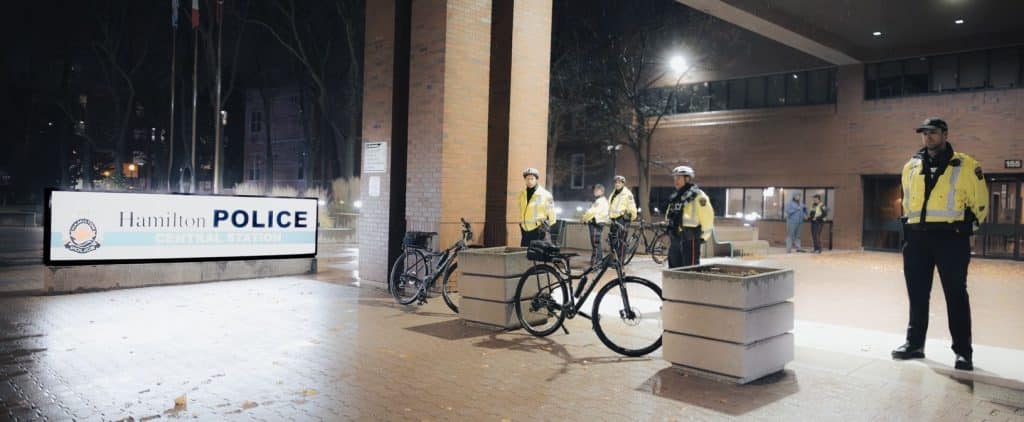
After a few speeches, people fan out onto Main Street and march towards Hamilton police headquarters about a kilometre away. The steady repetition of a few rotating chants — “justice for Erixon,” “no justice, no peace” and “we want answers,” —mostly dominate the night. But during every quiet moment, a few voices rise to exclaim that the police are “murderers,” and demand to know the names of the officers who reportedly shot Kabera four times at his dwelling. Then the previous rotating chants rise up again to overwhelm the more spontaneous cries. Proclamations that Black lives matter, and demands to defund police and reinvest in the communities they harm, have echoed loudly in Hamilton’s streets in recent years; they will not be heard tonight.
The gathering approaches the police station with chants of “one, two, three, four, we’re knocking on your door.” The same police force responsible for Kabera’s death has been following the march at a distance, and several of its officers stand outside the station.
The proverbial knocking at the police’s door is cautious. The cops have already sought to blame Kabera for their violence against him, and organizers seem conscious that any anger, no matter how justified, can always serve as the excuse for another violent police response.
For a vigil to also confront police at their station suggests a conflict: a strong desire to express righteous outrage runs against a fear that Black outrage is socially disqualifying and threatening. In every respectable venue — in interviews, investigations, inquiries, committees, town halls, council chambers, and so on — Black people have described the conditions that lead to our subjugation and death. The polite, formal documentation of these conditions has not changed them, and efforts to suppress anger during a public demonstration, while understandable, add to the pain of the situation.
John Mulwa, a Kenyan asylum seeker who successfully fought a deportation order in 2023, is one of the final speakers at the police station. “Eric is my brother, was my brother, and will forever be my brother,” Mulwa says. “He’s the man who was supporting me, who made sure I had something to eat when I came to Canada 10 years ago.” The crowd nods and avows — this is the man they knew.
As for the more volatile feelings in the street tonight, a Rwandan demonstrator named Nadia shares her anger about the misinformation police and the SIU spread about Kabera.
“Erixon just got killed, and we still don’t know why,” says Nadia in an interview, as the vigil ends and the hundreds assembled near the station rush to get out of the rain. “A lot of us suspect it was just because he is a Black man that he is no longer with us. So we’re trying to constrain ourselves,” she adds.
“It is sad because we should be able to experience the full length of our emotions without the fear that we’re going to be harmed for it in return.”
We’re counting on readers like you
The Resolve creates community-powered independent journalism centring and celebrating Black, Indigenous and communities of colour in Canada. If you think this work is important, join us and become a founding member of The Resolve.