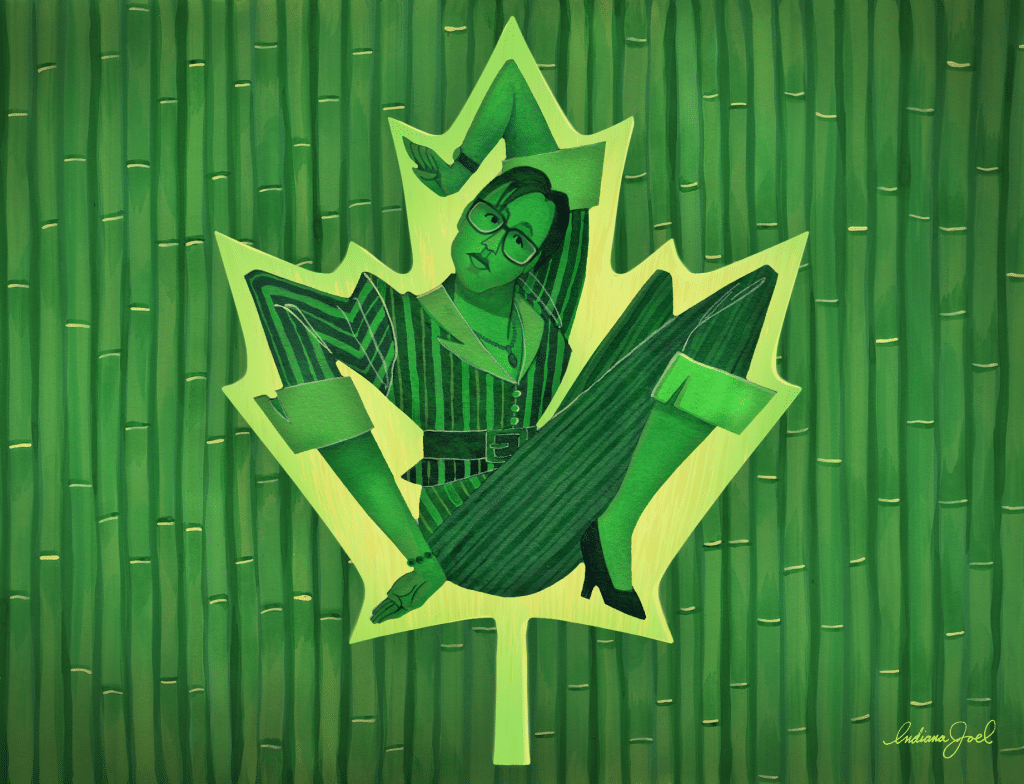
The year I became a person of colour, my heart broke in two places. This was not a coincidence. Some people of colour might come to this identity without encountering heartbreak, but I don’t know of any myself.
The first time my heart broke, I guess I could blame my own stupid inexperience. The second time, it was just an ordinary thing that happened, or maybe there was really no distinction between the two, other than my own ability to forgive myself for not being able to outrun every potential catastrophe.
Before I was a person of colour, I loved my country blindly. I accepted the histories that were taught at school, all that bland and boring Canadian history, taught by self-assured, well-meaning white men. “What history?” my dad would snort. It’s not like Chinese history, where you have to memorize that 10-ton highlight reel, three millennia deep of emperors, warring clans and palace intrigues. In this “new” land, anyone should be able to recite the whole works, write a nice essay, and ace that thing. What could be easier?
We were immigrants here, like the rafts, flotillas and planeloads of others before us, wide-eyed at the arrivals bay, and eager to take it all in, eager to please. We were Oriental, we were people from “independent” former British properties, we were Han Chinese, we were Cantonese-speakers, we were not the same, but we were not yet people of colour.
Telling our own stories.
Creating community-powered journalism that centres and celebrates Black, Indigenous and communities of colour in Canada.
We learned we were visible minorities. Statistics Canada gave all of us formerly illicit, recently approved citizens this box to tick. Visible minorities knew our place was to wave that flag, forget who we came from, and help them forget too.
A visible minority prides herself in fitting in agreeably wherever she finds herself. Agreeing was the price of safe passage. It came so naturally, I didn’t even realize how circumspect I had become, pretzelling into places and spaces never intended for me. The father of my children would say, “I hate how you do that,” and I had no idea what he was talking about.
The Cantonese language is characteristically precise about people like me: 竹升, a stem of bamboo, a slur. I grew up in an affluent Alberta suburb, so my parents were able to protect me from this heartbreaking pejorative until I was an adult, when I learned from a Toronto cousin that juk sing was a metaphor for a Chinese person raised in North America — a piece of bamboo that has drifted far from the thick grove of its ancestral watershed. A 竹升 that has washed up on the golden mountain of Turtle Island may resemble a Chinese person superficially, but we are empty inside. Instead of drawing up the richness of our ancestral language and culture from the blood-stained dirt of our motherland, our shallow roots drank in English, French, Spanish and Portuguese from a clean hydroponic coir mat.
The year I became a person of colour, my seven-year-old ran away.
It happened one Friday night, four days after Thanksgiving. It was late and we were arguing about the necessity of brushing teeth before bed. I had lost my temper and spanked him right before he ran. I remember hitting him with a wooden spoon on his open palm as hard as an adult woman could.
The next moment he was gone, the screen door swinging in the wind, just like in the movies.
Holding my five-year-old’s hand tightly in mine, I made an anxious search around the block, peering into the dark hedges and neighbours’ porches, before phoning 911.
“I learned from a Toronto cousin that juk sing was a metaphor for a Chinese person raised in North America — a piece of bamboo that has drifted far from the thick grove of its ancestral watershed.”
It came as a small horror to hear myself distil a child into a description: skin colour, hair colour, height, weight, age.
I may never be able to wash away the shame of having been a mother who made her child’s home so hostile that he had to flee into a dark downtown street. I imagine if a sky conference had been held that night by my ancestors, they would have agreed I was within my rights as a mother to spank that unruly North American child, who dared to rage and carry on in that way and ignore his filial duty to treat his elders with respect. But it is never right to weigh a parent’s rights against a child’s.
I know had I been able to confide that hideous act to my Poh Poh, she would have murmured a gentle rebuke. Maybe she would have reminded me she raised two boys too, and she had done so as a refugee in her own land, moving all the time to stay ahead of the front, my often angry Gung Gung too preoccupied with providing for the family to also give emotional warmth for his sons.
She would say what she always did: be patient, be patient, be patient. By example, she had taught me anger is never the way, even if you are tired from workplace drama, and parenting alone, and the boy just won’t listen and you don’t have any aunties or sisters around to help you raise the children up right. If her ghost had been hovering over the stairs that night watching as the baby she had held in her arms just before her death pitched himself outside with just the socks on his feet, her eyes would have grown dark with worry, and her prayer beads would have been clicking in her hands.
Anyway, I wasn’t thinking about my Poh Poh that night and I had no ancestral altar on which to beg forgiveness.
“Hold the line, I think we have him,” said the dispatcher.
My boy had gotten about a block up the sidewalk before a couple out for a walk stopped him to ask if he was lost. Of course he was not. “Do you need help?” they asked. No, but the mobile crisis unit was already in the neighbourhood for the usual Friday night troubles. I can’t recall how long it took for them to return my son, only that the anger that had fueled his flight had deflated into a familiar residue of shame.
Oh my god, the children’s father said, when he found out. We are in the system now.
My partner, like me, was the child of immigrants who arrived in the optimistic ’70s. But unlike me, he was raised a few blocks off the inner city, on the scrubby fringe that could still be called respectable. He often accused me of having no street smarts on account of my upbringing in the soft, snow white suburbs, among the immigrants who spoke Danish, Ukrainian and German.
Our boy looks native, he said, and look at what they do to native kids in this town.
What was worse, what neither of us could say out loud then, was I had become a stereotype of an abusive immigrant parent. I would not be able to say out loud the truth of what happened for many years.
By the time the social workers arrived, I had spent frenzied days cleaning the house. We needed to look orderly, like the respectable, income-earning family we were, a hardworking Canadian family with access to clean drinking water, a bedroom each, and good lawyers if necessary.
My partner came home from work to greet them with his armour on: a business suit, white shirt, striped tie, credentials.
We are not obligated to tell them anything, he had hissed to me that airless morning. They are not our friends.
In another place, they could have been. They were disarmingly young, standing on our welcome mat as fresh and innocent as a pair of Mormon missionaries, if missionaries had gel nails the colours of jelly beans. I wanted to trust them.
I remember the sound of their heels click-clacking through the house as they inspected our fridge and looked under the blankets of the children’s bunk bed. Workplace safety rules, they said by way of apology — they could not take their shoes off, we understood, right? “What school do your boys attend?” they asked, because they could interview them there, instead of alone, outside on the porch, if we preferred.
The year I became a person of colour, just a few months after my son ran away, I lost my job. It happened on a Friday, three days after my birthday. The boss had just bought an ice cream cake to celebrate, like he did every month for all the other staff on their birthday months. With just 20 of us, it was like a big family, that way. My colleagues had gathered around the lunch room table to sing “Happy Birthday,” even the ladies who hated me.
The staff list was full of middle-aged women, like me, primary caregivers to young children, balancing our desire for interesting careers with the need for regular kid-compatible hours. I was the only visible minority on the roster, but I was happy to be picking up the phone, and making chirpy conversation with everyone. The hours were regular and there were benefits, and that’s all I felt I could ask for at the time.
The job had started off well enough — we all smiled and shared cinnamon buns and coffee. But six months in, my performance review came in, full of anonymous tips from colleagues who had taken their concerns about me up to the boss. I had been making mistakes when I answered the phone and giving people wrong information, said one. I wasn’t making eye contact when being corrected, said another. Someone else saw me distracted by my phone during a meeting. When the lady from accounting would breeze in, saying good morning to everyone but me, I thought it meant I had one less friend in that office. I hadn’t realized it meant I had none.
I started to scrutinize my every action more than any micromanager possibly could. I started running at lunch, partly to deal with the stress, partly to avoid hanging out in the lunchroom. As I changed out of my running clothes in the storage closet to avoid having to change in the women’s washroom, I thought I was being agreeable. I didn’t notice the resentment rising up of having to hide so much.
It came as a relief when I was finally fired. They found some serviceable reason, like they always do when you have overstayed your welcome. They said it was just a chat, but when the boss and one of his managers invited me into the glass office, they closed the blinds.
The manager’s gel nails clacked on the table as she leafed through my file. The boss said he would do me the mercy of calling it a layoff instead of saying they had just cause, which, they wanted to assure me, they did. The manager twisted a strand of hair behind her ear. The boss cleared his throat.
I hid behind a brave smile, still trying to put them at ease. Thanks, I said. This was for the best, I agreed. I collected a cardboard box from the photocopy room and emptied my desk. The wind was at my back as I balanced the box on my bicycle handlebars for the short ride home.
When I told my friend what happened, he sighed. Then he told me a story I had never heard before. About how when he had been a child in that town, the police used to come around to his neighbourhood and just pick up kids like him. He couldn’t outrun them then, so they would beat the crap out of him. When they were done, they would let him back out on the sidewalk, bloody and bruised, to limp home to his grandmother, who could do nothing but tend to his wounds and be grateful nothing was broken. The first time it happened, he was the same age as my boys, maybe younger.
“They said it was just a chat, but when the boss and one of his managers invited me into the glass office, they closed the blinds.”
Oh my god, I said. We sat in silence.
Then we shared a few slices of bread and a can of sardines at a picnic bench where we had taken a break from a bike ride through town. I watched him use the bread to sop up the last of the oil from the can, a habit I had done countless times before, with countless other cans of sardines. We shared some jokes at the expense of the invisible majority, and laughed without bitterness.
This friend, my children’s father, and countless other people of colour, gathered me up after that year, without pity, without guilt, without judgment, they welcomed me into their circles with their stories, their teachings and their laughter. I heard an elder say we are each other’s medicine, and the year I became a person of colour, I understood that to be true.
We are people of colour, sometimes able to join together to share the warm sun, still shining, the grass, still green, and the sound of the creek, still running, as it always has. My sons are both still with me, and I don’t fight like that about brushing teeth any more. My friend, against the odds, grew to become an old man who was able to ride his bicycle as fast as the wind, faster than the armoured police vehicles that still lumber through his town, driven by fearful confused men who still believe their fists and guns can defend anything worth protecting.
The year I became a person of colour, I began to heal everything that was ever wrong with me, and every topsy-turvy relationship I ever had, starting with the relationship I had with myself. This was not a coincidence. Some people may become whole without confronting their stories and identities. But I don’t know of any myself.
We’re counting on readers like you
The Resolve creates community-powered independent journalism centring and celebrating Black, Indigenous and communities of colour in Canada. If you think this work is important, join us and become a founding member of The Resolve.